


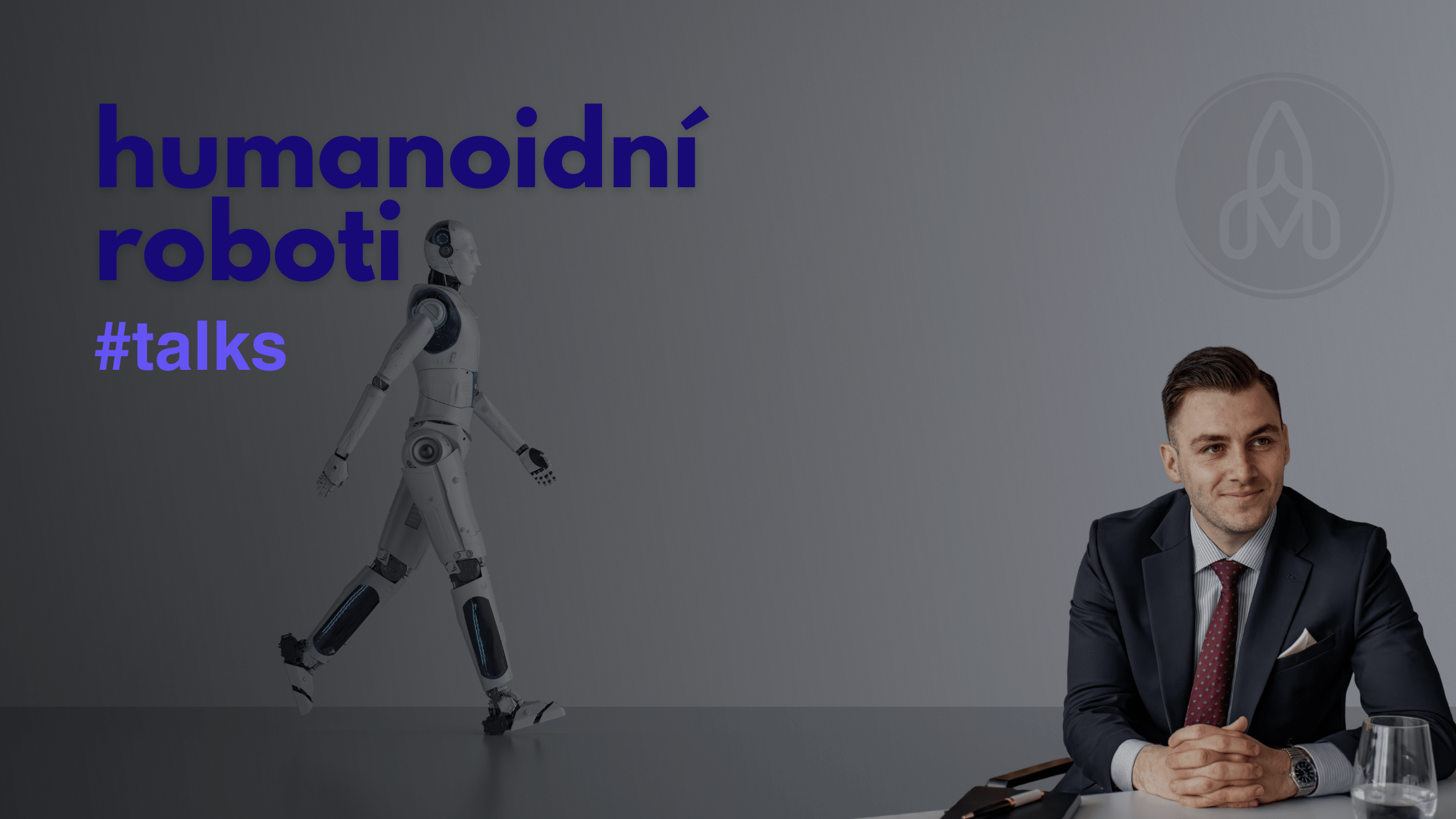
We often come across funny videos of humanoid robots doing things that make no sense at all. They run through a warehouse, trip over nothing, bump into glass, or accidentally slap someone. It’s amusing mainly because the robot looks like a human, so the brain automatically interprets it through the lens of human behavior. Our mind can’t help but find it funny.
But now to the important part. Humanoid robots are becoming one of the biggest technological bets of the next twenty years. For the first time in history, several factors have come together simultaneously: sufficient chip performance, advanced AI, progress in batteries, better servomotors, and, most importantly, capital actively searching for the next megatrend after AI software. The physical world is merging with the digital one, creating a completely new industry: robotic labor. Once these layers align, a new type of economy emerges. Not digital. Physical.
And that is exactly why we are following it so closely.
Most of us have seen the movie I, Robot, or at least heard of it. The idea of a newer, more capable generation of humanoids replacing the old one. And why is this concept now becoming real — at least the “older generation” part from the movie?
Until recently, one crucial component was missing for humanoid robots to scale: AI capable of understanding and planning. That changed only in the last few years.
Today, we have a combination the world has never seen before:
• a computer that can see
• a computer that can understand
• a machine that moves like a human
• training on real-world data
• low-cost manufacturing of motors and batteries
• capital flowing into the sector
• and the biggest labor shortage in decades
This is why sci-fi is flipping into reality. Not because one new company appeared, but because all the required layers emerged at the same time. Including the economic one.
One thing is vision.
Another is reality.
Robots are already working in specific locations today:
Amazon
Amazon has begun testing the humanoid robot Digit in its warehouses. This is not marketing. Digit physically carries totes, manipulates goods, and fills inventory positions. Robots are replacing thousands of steps workers used to walk every day. This is not the future. This is pilot deployment.
Agility Robotics – Digit
The first humanoid robot deployed in logistics at scale. It handles box manipulation, sorting parcels, and operating in environments that were previously reserved exclusively for humans.
Unitree – G1 and H1
Still mostly used for research and smaller businesses, but they can be purchased without restriction. They walk, carry objects, avoid obstacles, and perform basic physical tasks.
Tesla Optimus
Not commercially available yet, but used internally at Tesla. It manipulates components, assembles objects, and learns movements from human demonstration. Tesla is training its own form of real-world AI directly through this robot.
Current humanoids already handle simple but extremely valuable tasks:
• carry shopping bins
• take out the trash
• sort goods
• pick objects off the floor
• move boxes
• perform simple assembly line tasks
• slice vegetables (in research models with safety constraints)
The last example sounds trivial, but slicing and controlled manipulation represent a peak challenge in fine motor control.
The humanoids currently available are mostly from Unitree and a few specialized manufacturers:
• Unitree G1 – the most affordable full humanoid platform, basic motion, manipulation, ideal for development
• Unitree H1 – full-size biped with excellent stability, intended for serious research
• Unitree G1 EDU – a version designed for universities and labs
• Booster Robotics T1 – another commercially available platform
• XTRON ROBAN – a professional biped used in test environments
• Alpha 1Pro – an educational humanoid, low-cost, great for experimentation
This is not mainstream yet. But it is no longer science fiction.
The technology is here. What is not here yet:
• mass-scale manufacturing
• legislation
• safety standards
• long-term operational testing
• robustness in chaotic, unpredictable environments
• a proven business model (likely robot-as-a-service)
That’s why broad adoption will appear in roughly five to ten years.
Not because the technology is impossible.
Because the market must catch up to the technology.
This is the key section. The big opportunity. But only in certain segments.
This is the core of movement. Yaskawa, ABB, Siemens, Rockwell, Moog, Harmonic Drive.
Stable, cash-rich industrial firms. Reasonable valuations.
This segment offers genuine balance, and unlike many AI companies today, it does not carry extreme risk. It allows investors to participate steadily in the robotics revolution. There is also a realistic scenario where key players in this sector form strategic partnerships, which could strengthen individual positions and accelerate their role in the emerging ecosystem.
The brain of the robot needs a place to run.
Microsoft, Alphabet and Amazon control most of the world’s compute infrastructure.
Alongside them stand REITs such as Equinix and Digital Realty, which build the physical layer behind this ecosystem.
However, it is already becoming clear that demand for data centers is not growing as quickly as expected and is increasingly constrained by extreme energy consumption. As a result, this sector will need new, stable energy sources, otherwise its growth will slow.
Nvidia with its Isaac stack, Tesla’s Optimus stack, Figure AI, Physical Intelligence.
This is where real value may appear.
But it is also the layer with the highest technological risk.
Daifuku, Dematic under KION, Vanderlande.
These companies will actually deploy robots into factories and warehouses.
Without them, no robot reaches real production.
Unitree, Agility, Figure, Boston Dynamics, Tesla.
Each has different levels of risk, different timelines, and different paths to profitability.
We do not follow Tesla because of cars, autonomous driving, or Elon Musk.
The main reason is the potential behind the Optimus robot. Musk’s personal brand helps because it increases the probability that Tesla will not run out of capital. The cult following and broad access to investors give Tesla a safety buffer. Tesla today is not interesting because of cars. It is not interesting even because of FSD. It is interesting because of investor psychology around Tesla and because humanoid robots represent a market in which Tesla may genuinely become number one.
Tesla has several key advantages:
• the largest real-world dataset in existence
• its own training chips (Dojo)
• vertically integrated production of motors and actuators
• factory capacity for mass hardware manufacturing
• access to enormous capital
• a team focused entirely on robotics and real-world AI
If Tesla succeeds, investors will stop valuing it based on a car P/E.
They will value it based on the number of robots deployed.
That is a completely different business model.
• today’s market: 30 billion USD
• by 2035: 1.5 to 3 trillion
• by 2040–2050: 10 to 20 trillion
This is equivalent to the size of the automotive, cloud and semiconductor industries combined.
And most importantly, this is not a trend. It is labor.
This technology may become one of the biggest opportunities of the next twenty years. But it is also a risk. Robotics will be capital-intensive and requires the integration of hardware, AI, legislation and manufacturing. Some companies will ride the entire wave. Others will disappear before they reach meaningful revenue.
What will decide the winners:
• who can build AI for the physical world
• who can manufacture at scale
• who has access to capital
• who can deliver a product, not a prototype
• who can actually deploy robots inside businesses
Robotics is a long-term play.
But if humanoids succeed, it will be one of the biggest changes in labor since the invention of the assembly line.
This article is for informational purposes only and does not constitute investment advice. Investments in financial markets are associated with risks and it is important to conduct your own analysis before making investment decisions.