



US-Iran tensions are rising.
Oil and the Japanese yen often react before equities. It doesn’t take a war to shake markets. It only takes a higher perceived chance of escalation.
Negotiations are ongoing over Iran’s nuclear program and sanctions. On the surface it looks like the usual noise: statements, warnings, a few headlines, then silence again. But markets don’t move on the volume of news. They move on probabilities.
Why is a possible U.S. strike even being discussed? Because the same pressures keep colliding: the nuclear issue, sanctions, and regional clashes via allies and militias. In that mix, one incident, one miscalculation, or a harder retaliation can quickly push the situation into a new phase.
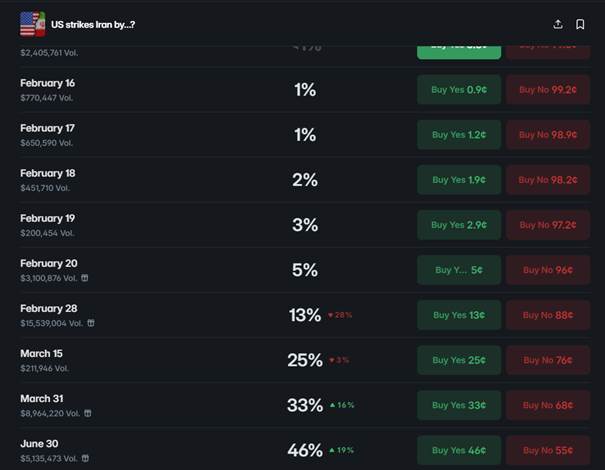
Polymarket is a useful thermometer here. It doesn’t predict. It shows what probability the market is assigning right now. At the moment, it’s roughly pricing a 13% chance by the end of February 2026, 33% by the end of March 2026, and 46% by the end of June 2026.
What it does to oil
A short conflict in the headlines can still create a big move in price.
Oil doesn’t have to physically disappear from the market. It’s enough for certainty to drop. The market adds an oil risk premium (a surcharge for uncertainty). The reason is straightforward: insurance, shipping, security, and the general sense that conditions could deteriorate.
And oil isn’t just “energy.” It feeds into inflation. Inflation pressures interest rates. And rate pressure raises stress across markets. Even a temporary oil risk premium can change sentiment fast.
Why it can spill into the Japanese yen
People often wonder why Japan gets dragged into geopolitics. The mechanics are simple.
The “yen carry trade” is a strategy where investors fund themselves in yen and buy higher-yielding assets elsewhere. It works best in calm markets. It needs a stable currency and low volatility (small daily swings).
But the carry trade behaves like short vol (a bet on calm: it earns when markets are quiet and loses when volatility jumps). When volatility spikes, risk managers tighten limits, margin requirements rise, and leverage has to come down. Then you get an unwind (fast closing of leveraged positions). And because many positions were funded in yen, investors buy yen back. The yen strengthens, which often accelerates the closing process.
There’s another layer too: Japanese capital is massively invested overseas. When a currency shock hits, changes in hedging and capital flows can tighten liquidity outside Japan as well.
But what does oil have to do with the yen?
Simply this: when oil jumps on fear (for example, geopolitics), markets get nervous, swings increase, and investors start quickly closing risky, leveraged trades. Many of those trades are funded in yen, because the yen is often used as a cheap “loan.”
So when oil spikes, the market tends to think three things:
Energy will get more expensive - costs rise for companies and households.
Inflation could move up - central banks may stay tougher on rates.
Uncertainty rises - markets swing more (higher volatility).
And higher volatility is exactly what hurts yen-funded trades. People close them to reduce risk. To close them, they have to buy yen back and repay the “loan.”
What to watch now
This can still look like noise because talks are ongoing. That’s exactly why it’s worth keeping the scenario in mind for future decisions.
Oil: whether the move holds for several days or fades quickly
USD/JPY: whether the yen strengthens fast and in jumps (often a sign leverage is being cut)
Japanese overseas behavior: signs of repatriation (capital coming home) can tighten liquidity elsewhere
Polymarket: whether strike probability trends higher or just bounces around
Note: This text is for informational purposes only and does not constitute investment advice. Investing involves risk, including loss of capital.